Monday, 22 February 2016
Representation
Me: What does your job involve?
Ellie: I'm a waitress
Charlie: Are you very good with customers?
Ellie: I am
Me: Do you get tips?
...
Charlie: What did your job at Diesel involve?
Des: Jeans.
Me: Did you sell many jeans?
Des: Yes
Ellie:How did that go?
Des: It was great.
Charlie: Can you tell anyone their jean size?
Des: yeah
...
This transcript of our conversation in lesson opposes Zimmerman and West's dominance theory. The girls seem to be asking questions and leading the conversation. I start the conversation by asking an interrogative to Ellie. After she replies Charlie continues to ask another. This shows women being dominant in a conversation as Des, the only male in our group, did not interrupt or take over the conversation. However the girls in the group are more comfortable around each other and this may have contributed to how we interacted with each other. By asking questions quickly after Ellie had answered may seem as though Charlie and I are using constraints to reduce Ellie's airtime, However this was not the case we were trying to keep the conversation flowing.
In the second part of the transcript we can see the interaction between three females and a male which clearly does not support the dominance theory. The females hold dominance through the conversation by asking interrogatives in latched talk so that the conversation is rapid without hesitation. The interrogatives are asked so quickly after Des' answers we could have been interrupting him which is the opposite of stereotypical mixed gender conversations. This may be because there are more females. The interrogatives we were asking did show an interest in what others had to say as we asked questions about their occupation,

Saturday, 13 February 2016
Gender representation
https://www.youtube.com/watch?v=ufsnk27SK9I
This link takes you to the advert for a pink glue by Pritt stick. The advert straight away says 'just for girls'. The words are written in a pink bubble with yellow flowers surrounding it. This is stereotyping typical traits girls are supposed to like. the add then goes on to say 'Because it's just for girls, it's pink' again this is pushing that girls must love all these stereotypical qualities. The use of the adjective 'Just' implies that no one can use it except girls, representing girls as different to boys. This can relate to John Gray's book Men are from Mars, women are from Venus which discusses how different men and women are.
'It's perfect for making cards, posters and scrapbooks.' This implies that these are all activities girls do. The glue has no traits different from the gender neutral, white, original Pritt stick besides being pink and therefore this makes it for girls in the eyes of the company.
 This advert was made by Bic for women day. The advert caused a lot of upset as it seems to create an image of men being smarter than women. 'think like a man' was the part of the picture that caused the most upset as it implies that women's thoughts are deficient. This relates to the deficit theory by Lakoff. The advert was originally made to celebrate women but it seems to empower men more. The women in the picture is wearing a shirt and blazer which is typically what a man would wear. Although the graphology of the text is not stereotyping women it comes across as boring and does not seem empowering.
This link takes you to the advert for a pink glue by Pritt stick. The advert straight away says 'just for girls'. The words are written in a pink bubble with yellow flowers surrounding it. This is stereotyping typical traits girls are supposed to like. the add then goes on to say 'Because it's just for girls, it's pink' again this is pushing that girls must love all these stereotypical qualities. The use of the adjective 'Just' implies that no one can use it except girls, representing girls as different to boys. This can relate to John Gray's book Men are from Mars, women are from Venus which discusses how different men and women are.
'It's perfect for making cards, posters and scrapbooks.' This implies that these are all activities girls do. The glue has no traits different from the gender neutral, white, original Pritt stick besides being pink and therefore this makes it for girls in the eyes of the company.
This video shows all the negative connotations there are around women and how they act.When a female word has a negative connotation its called semantic derogation. This video shows just how women can be labelled with such negative words when their actions are no different to men. Although the video is overall trying to give a positive message it does reflect how negativity women are seen in society. Lakoff believes that women's language is deficient and men's language is the norm. This negative look on women is what the video is trying to stop.
This advert was made by Bic for women day. The advert caused a lot of upset as it seems to create an image of men being smarter than women. 'think like a man' was the part of the picture that caused the most upset as it implies that women's thoughts are deficient. This relates to the deficit theory by Lakoff. The advert was originally made to celebrate women but it seems to empower men more. The women in the picture is wearing a shirt and blazer which is typically what a man would wear. Although the graphology of the text is not stereotyping women it comes across as boring and does not seem empowering.Tuesday, 2 February 2016
Charity analysis

The verb 'traded' on the picture at the top reflects how poorly the animals are being treated. The noun 'scrap' also on the picture reflects the terrible way the puppies have been cared for and compares it to how you would treat rubbish.
This is the homepage of the website so they have put all the main features they want you to see. Please donate is put in a red/pink box which contrasts with the blue/ green theme of its surroundings. This makes it stand out and show its importance. The other words in boxes of the same colour are also important such as'get involved'.
The target audience of the website would be animal lover or people who are interested in animals as they would have to search it to find it. The website appeal to these people as it gives many options to help or learn about animals.
Sunday, 31 January 2016
Analysing song lyrics
I'm gonna pick up the pieces
And build a Lego house
When things go wrong we can knock it down
My three words have two meanings
There's one thing on my mind, it's all for you
And it's dark in a cold December, but I've got ya to keep me warm
And if you're broken I'll mend ya
And keep you sheltered from the storm that's raging on now
I'm out of touch, I'm out of love
I'll pick you up when you're getting down
And out of all these things I've done I think I love you better now
I'm out of sight, I'm out of mind
I'll do it all for you in time
And out of all these things I've done I think I love you better now
I'm gonna paint you by numbers and color you in
If things go right we can frame it, and put you on a wall
And it's so hard to say it but I've been here before
And I'll surrender up my heart and swap it for yours
I'm out of touch, I'm out of love
I'll pick you up when you're getting down
And out of all these things I've done I think I love you better now
I'm out of sight, I'm out of mind, I'll do it all for you in time
And out of all these things I've done I think I love you better now
The writer uses a metaphor of a Lego house to discuss himself and how he would like to be in the future "It's so hard to say it but I've been here before and I'll surrender up my heart and swap it for yours" He is still stuck in his old habits and he is using the idea a of swapping his heart to reflect swapping all he cares about now to be the person he wants to be.
"If you're broken I'll mend ya and keep you sheltered from the storm that's raging on now...I'll pick you up when you're getting down... " The writer is writing from a first person to the love interest. He uses 'sheltering from the storm' as a metaphor for helping through hard times. He goes onto explain this further by adding 'I'll pick you up when you're getting down... " This almost romanticizes the struggles of the person as he tries to prove his love by offering to help.
"I'm out of sight, I'm out of mind I'll do it all for you in time" These lyrics are written about how the other person may have tried to forget about him or cut him out of their life 'out of sight, I'm out of mind'. But he will still do everything he can to fix things. 'I'll do it all for you in time'. The writer doesn't use a verb to say what exactly what he will do which emphasizes the 'all' and the extent he will go to so he can win her back.
"I'm gonna paint you by numbers and colour you in, If things go right we can frame it, and put you on a wall" The paint you by numbers is a metaphor for fixing someone. 'colour you in' could mean that he's going to fill her with love/happiness as if he were colouring in a picture he's going to colour her in. The use of the verb 'colouring' reflects how he wants to add colour to her life and brighten it up as when you colour a picture it usually completes. To had colour to a picture is often seen as improving it or completing it.
Thursday, 10 December 2015
Guardian article on accents
Do accents cause as many problems as we think?
More than a quarter of British people feel discriminated against because of the way they speak.
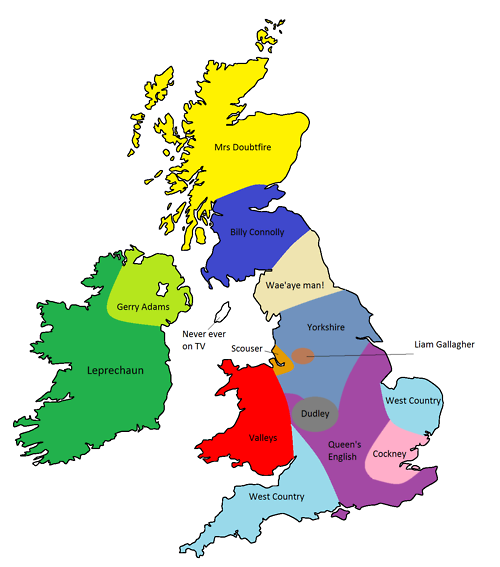
Accents are either something you are proud of or a feature you try to disguise. When discussing accents with another people may often try to make their accent stronger to prove a point. Others however may begin to try and talk in received pronunciation. This can depend on the stigma your accent of origin carries with it.
Stronger accents can often be linked to a stronger sense of pride in your place of origin. However these accents are the ones that the majority of the time are discriminated against. The Brummie accent is one of the more distinctive accents in the UK, yet in a recent survey brummie was found to be the least intelligent sounding accent.
In this post-modern society we live in, you would think that discrimination of accents would be a minor issue but according to new research 80% of employers have admitted to making discriminating decisions based on peoples accents. But experts say that the discrimination does not come from the way people sound, but because of the regional area of their accent. However in a recent study results showed RP sounding most intelligent when put next to Brummie and Scouse, making you wonder if it is the place of region or the sound of the accent itself.
 |
| Betray you origins to avoid stereotype discrimination? |
More than a quarter of British people feel discriminated against because of the way they speak.
Accents are either something you are proud of or a feature you try to disguise. When discussing accents with another people may often try to make their accent stronger to prove a point. Others however may begin to try and talk in received pronunciation. This can depend on the stigma your accent of origin carries with it.
Stronger accents can often be linked to a stronger sense of pride in your place of origin. However these accents are the ones that the majority of the time are discriminated against. The Brummie accent is one of the more distinctive accents in the UK, yet in a recent survey brummie was found to be the least intelligent sounding accent.
In this post-modern society we live in, you would think that discrimination of accents would be a minor issue but according to new research 80% of employers have admitted to making discriminating decisions based on peoples accents. But experts say that the discrimination does not come from the way people sound, but because of the regional area of their accent. However in a recent study results showed RP sounding most intelligent when put next to Brummie and Scouse, making you wonder if it is the place of region or the sound of the accent itself.
Tuesday, 1 December 2015
Milroy 1987 Belfast accents
- Milroy researched three working class areas within Belfast. These three areas have high unemployment. The places were Ballymacarrett, Hammer and Clonard. Milroy became part of the three communities playing the part of a friend of a friend.
- Milroy researched correlations between integration of individuals in the community and the speech of each individual. She gave each person a Network Strength Score from 1-5. When 1 is the lowest.
- This was given depending on the individuals own knowledge of others in the community, the workplace and at leisure activities. She then studied the individual’s linguistic variables.
- Her results showed that people who used the language of the region (vernacular) had a higher Network Strength score.
- People who used the language, mainly men, were part of close social groups. The regional language is used less by women because they are in less tight social group.
- Milroy studied interview style and spontaneous style language. In the younger male group, they used more PULL variable, women used SS (spontaneous style) 20% compared to 61% of men. E.g. pronouncing 'hand' as 'hound'.
- All the groups Used words such as 'mo'er' instead of 'mother'. Mainly men used this in IS and SS situations but women did use it too.
Bibliography
http://www.putlearningfirst.com/language/research/milroy.html
https://prezi.com/imbhlnfxy2re/milroy-and-milroy-belfast-study/
Tuesday, 17 November 2015
Jenifer Lawrence response
The context of this text is Jennifer Lawrence angered by the discovery that she is earning less than her male co-workers. She talks about how she was a main character in the film but was not being paid equally to the males she acted along side. She talks about men being able to get what they want by asking but when she tried to do this she was turned down. She gives of a feeling of anger in the text due to the way she has been treated.
It is believed that males use more swear words when speaking, Jennifer uses a lot of swear words to push her outrage onto the reader. An example of this "Fuck that." This is more effective as it evokes a reaction out of the reader. This is because women stereotypically use empty adjectives and weak sentences that aren't to the point. This pushes Jennifer's point across even more as she comes across more 'masculine' which contrasts what is expected. She is also very to the point which is a stereotypically masculine trait. She talks about talking to someone who works for her "I spoke my mind and gave my opinion in a clear and no-bullshit way". This is seen as a masculine thing to do, to be concise and to the point. The reaction she gets from this goes to show how women and men can speak however they want, but if it's not socially accepted or the norm then they will not be treated equally. However Jennifer does use 'female' language in the text. She does not include a lot of humour which according to Lakoff 'women do not have a sense of humour'. She does make a few sarcastic comments, for example "I found out how much less I was being paid than the lucky people with dicks". This does have serious undertones and the rest of the text is mostly serious. Stereotypically if a male had written this he would have used humour to get his point across.
I agree with her conclusion that it is completely wrong for women to not be paid equally to men. It was right of her to question it with others and their reaction of acting as if she was being unreasonable was wrong. I agree it would have been responded to differently if it were a male querying the same situation. Like Cameron believes that gender is something you do not something you are, I agree. Jennifer proves this by using masculine language aspects rather than using empty adjectives and tag questions.
Subscribe to:
Posts (Atom)